
By Styora Decors | Interior Styling & Decor | 9 min read
Everyone in the living room looks at the TV wall every evening. Yet in most homes it’s a black screen, a nest of wires and a shelf of mismatched gifts.
Good TV unit decor has very little to do with buying a bigger unit or building a panelled feature wall. It comes down to four things: balancing the wall, choosing a handful of objects for the console, hiding the wires and getting the light right. Do those well and the TV wall looks finished when the screen is off, and fades into the background when it’s on.
Almost everything below is pure styling, with no renovation and no carpentry, and most of it works in a rented flat too. Where an idea genuinely needs a carpenter, painter or electrician, we’ll say so plainly.
TV unit decor starts with balance
Before you add a single object, look at where the TV sits on its wall. In TV wall design, that one fact decides how everything else should be styled.
If the TV is centred
A centred TV asks for calm, near-symmetrical styling: not identical twins on each side, but equal visual weight. A table lamp at one end of the console can balance a tall vase of dried branches at the other.
If the TV is off-centre
In many flats the TV ends up wherever the builder left the cable and power points. Don’t fight it. Give the empty side a counterweight, such as a tall plant, a floor lamp, a large leaning frame or a slim bookshelf, and the off-centre placement starts to look deliberate.
Either way, the console should be noticeably wider than the TV. A 55-inch screen is about 122 cm wide, so a console of 150–180 cm sits comfortably beneath it; a narrower one looks top-heavy.
What to put on a TV unit: the three-to-five object rule
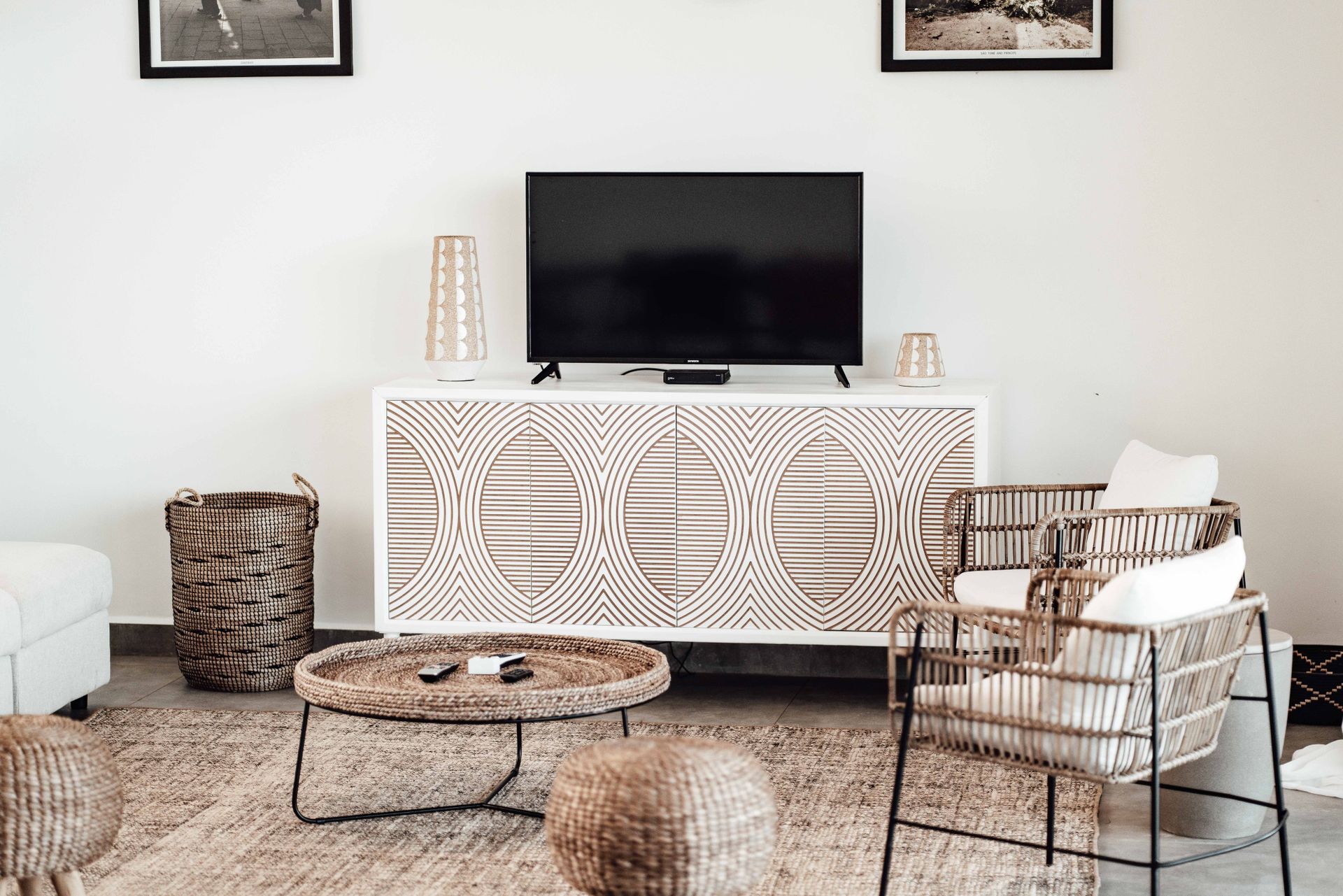
Most consoles hold far more than they need. Three to five objects on top, grouped rather than scattered, is usually enough. A simple formula:
- One tall piece at one end: a table lamp, a tall vase with a few branches or a snake plant in a ceramic pot.
- One medium grouping at the other end: two or three coffee-table books stacked flat, with a small bowl, candle or brass object on top.
- One low piece in between: a tray, a small sculpture or a lidded box for the remotes.
Most Indian living rooms juggle three or four remotes: TV, set-top box, soundbar and AC. A lidded box or a small cane tray keeps them corralled.
Keep the middle low
Anything directly under the screen should sit lower than its bottom edge, or it cuts into the picture and can block the remote sensor or a soundbar. Style the ends; keep the centre for flat, quiet pieces.
Add one living thing
A plant softens the hard edges of electronics. Snake plants, ZZ plants and money plants cope well with the lower light most TV corners get. Water them away from the console; spills and electronics don’t mix.
Edit the showcase
In many Indian homes the TV unit doubles as a showcase for silver gifts, souvenirs and wedding mementos. Display a few favourites grouped by material, all the brass or all the silver together, and rotate the rest. Idols and puja items usually feel more respectful in a dedicated mandir corner than beside remotes and wires.
For lamps, vases and planters we’d happily recommend, browse our curated decor finds.
TV wall decor: art, shelves and the black rectangle
Good TV wall decor turns the screen into part of a composition instead of a lone black rectangle on a big white wall.
Flank the screen instead of crowding it
Place art beside the TV rather than above it, where it pushes everything too high and crowds the screen. Two vertical frames suit a centred wall; one larger piece on the open side balances an off-centre one. Line frames up with the top or bottom edge of the TV so the arrangement reads as one unit.
Renting? Lean a large frame against the wall at one end of the console and overlap a smaller one in front. Floating shelves either side of the TV look smart too, but they need drilling, so check with your landlord first. For more ideas, see our guide to what you can hang on a wall.
Make the black screen disappear
A switched-off TV is the biggest dark shape in the room. Three ways to help it blend in:
- A deeper wall colour: charcoal, deep green or navy makes the black screen almost vanish. This one needs a painter, and your landlord’s yes in a rental.
- Dark frames nearby: black or dark-wood frames arranged around the TV let the screen read as one more frame.
- An art mode: if you’re buying a new TV anyway, some models display artwork while idle; check the specifications.
Not sure which of these suits your wall? Pulling a TV wall together with what you already own is exactly what our interior styling and decor services do.
How to hide TV wires without breaking the wall
Dangling wires undo every other effort on the TV wall. You don’t need to cut channels into the plaster to hide them:
- Adhesive cord covers: slim channels that run from the TV down to the socket. Paint them the wall colour and they almost disappear. Test the adhesive on a hidden patch first, as some lift paint when removed.
- Cable sleeves: one fabric or spiral sleeve turns four loose wires into a single neat line.
- Clips under the console: small adhesive clips along the back or underside keep cables off the floor and out of sight.
- A cable box: hides the extension board and its tangle of adapters. Keep set-top boxes and routers ventilated; they run warm.
Honest note: running wires inside the wall or adding a socket behind the TV is an electrician’s job. Everything else here is a weekend fix.
Lighting behind and beside the TV
Light changes how the TV wall feels after dark, and how comfortable it is to watch.
- A soft LED strip behind the TV eases the contrast between a bright screen and a dark wall, and gives the wall a gentle glow. Choose warm white rather than colour-changing modes.
- A table lamp on the console (one at each end on a centred wall) adds a warm pool of light at seated eye level.
- A floor lamp beside the unit doubles as the counterweight for an off-centre TV.
- Warm bulbs: stick to 2700–3000K in the living room, and keep every bulb in the room the same colour.
Before you settle on placement, sit down with the TV off and check the screen for reflections of lamps, windows or mirrors; move the lamp aside or add a sheer curtain. Our home lighting design guide explains how to layer light across the whole room.
At Diwali and other festivals, keep real diyas and candles off the TV unit, away from the wires and curtains. LED diyas give the same glow there safely.
TV unit design for living room: refresh or replace?
If your unit is the right size, refresh it instead: declutter the shelves, add fabric or cane baskets to open cubbies, swap dated knobs for brass or wooden ones (a screwdriver job) and restyle the top using the formula above.
If you are choosing a new one, most TV cabinet designs for living rooms fall into three groups:
- Freestanding consoles: low units on legs or a plinth. They move with you, suit rentals and are a pure styling decision.
- Wall-mounted floating units: clean-looking and easy to mop under, but they need drilling and proper fixing by a carpenter.
- Built-in wall units: full-height storage, lofts, panelling, fluted backs or backlit niches. These are carpentry builds that take weeks, plus an electrician for any lighting.
Whichever you choose, favour closed storage over open shelves. Dust settles quickly in Indian homes, and doors mean fewer things to wipe every week.
Rug, seating and viewing distance
A TV wall only works if the seating works with it.
- Screen height: the centre of the screen should sit near seated eye level (more on this in the FAQs below). A TV mounted high above a tall cabinet strains necks.
- Viewing distance: the usual rule of thumb is 1.5 to 2.5 times the screen’s diagonal, roughly 2–3.5 m for a 55-inch TV. With a 4K screen you can sit at the closer end comfortably.
- The rug: choose one big enough for at least the front legs of the sofa and chairs, so the seating and TV read as one zone. Indian living rooms are shoe-free and movie nights often spill onto the floor, so a soft, washable cotton dhurrie and a few floor cushions earn their place.
For sofa placement, layout and the rest of the room, our living room decoration guide goes deeper.
✨ Stylist’s tip
Before you buy anything, take a photo of the TV wall from your sofa and switch it to black and white. Colour hides imbalance; greyscale shows it instantly. You’ll see which side is heavier, how much the black screen dominates and where the eye has nowhere to rest, which tells you exactly what the wall is missing.
Common mistakes to avoid
- Mounting the TV too high. If you tilt your head back to watch, it’s too high.
- A console narrower than the screen. It makes the wall look top-heavy and unfinished.
- Turning the unit into a showroom. Twenty small objects read as clutter; three to five read as styled.
- Mirrors opposite or beside the screen. They bounce glare straight back into the picture.
- Leaving the wires on show. One cord cover does more for the wall than a new vase.
FAQs
What should I put on my TV unit?
For everyday TV unit decor, three to five objects is enough: a tall piece at one end, such as a lamp or plant; a medium grouping at the other, like stacked books with a small bowl on top; and a low tray for remotes in between. Keep anything under the screen below its bottom edge.
How can I decorate the wall behind my TV without drilling?
Lean a large frame against the wall on the console and overlap a smaller one in front. Add adhesive cord covers for the wires, a plant or floor lamp beside the unit for balance and a soft LED strip behind the TV. All of these move house with you, so they suit rented flats.
What colour should the wall behind a TV be?
Darker or mid-tone walls such as charcoal, deep green, navy or warm brown help a black screen blend in when it’s off, and they feel easier on the eyes in the evening. A stark white wall makes the screen stand out more. Painting is a job for a painter, so in a rental check with your landlord first.
How high should a TV be mounted on the wall?
As a general guide, the centre of the screen should be close to seated eye level, about 100–110 cm from the floor for most sofas, which keeps your neck comfortable. Many TVs are mounted far higher, often above a tall cabinet; lowering one is a quick job for an installer.
Want a TV wall that looks finished, without renovation?
Book a free 15-minute demo call with Styora Decors. Zero obligations — we’ll understand your space and recommend the right plan.
Follow @styoradecors on Instagram and Styora Decors on YouTube for styling reels, TV wall ideas and room makeovers for Indian homes.