
By Styora Decors | Interior Styling & Decor | 8 min read
Most living room rugs are bought for their colour and turn out a size too small — floating in the middle of the floor like an island while the sofa sits stranded on bare tiles.
The right rug for living room seating does more than cover the floor. It pulls the sofa, chairs and coffee table into one group, softens a hard marble or tiled floor and quietly sets the colour story for the whole hall. Get the size, material and colour right and even a simple flat-woven dhurrie makes the room look finished.
This is a stylist’s buying guide, so everything here is pure styling — no renovation, no flooring work. It’s how we approach rugs at Styora Decors, a home styling studio: furniture first, then the floor, then colour. For the rest of the room, see our complete living room decoration guide.
Choosing a rug for living room seating: start with size
A living room carpet rug that’s too small is the most common rug mistake of all. Size it to the furniture, not to the bare patch of floor in the middle. A few rules do most of the work:
- Front legs on: the front legs of the sofa and every chair rest on the rug. This joins the seating into one group and suits most Indian living rooms.
- All legs on: every piece sits fully on the rug. It looks generous and works in large halls.
- Wider than the sofa: the rug should run at least 15–20 cm past each end of the sofa.
- A floor border: leave roughly 30–45 cm of bare floor between the rug and the walls, so the floor frames it.
- Long side along the sofa: run the rug’s longer side parallel to the sofa, with the coffee table fully on it.
- The TV unit stays off: the rug belongs to the seating group, so in most halls the TV unit sits on bare floor.
Common sizes, and where each one fits:
- 4 × 6 ft: a reading corner, or in front of a two-seater in a compact hall. Under a three-seater it usually looks too small.
- 5 × 8 ft: the workhorse for compact living rooms — a three-seater with one or two chairs, front legs on.
- 6 × 9 ft: a three-seater with two armchairs, or a 3+2 set, in a mid-sized hall.
- 8 × 10 ft and up: large rugs for living room layouts with an L-shaped sofa or a 3+2+1 set. Every front leg sits comfortably, and in a big room all of them can.
To size it quickly, take the sofa’s width and add 30–40 cm: that’s your minimum rug length. For the depth, measure between the front legs of the sofa and the front legs of the seat opposite, then add about 30 cm so both sit comfortably on the rug.
Before you buy, mark the outline on the floor with masking tape and live with it for a day. Check that doors clear it, too — a thick rug can catch the bottom of a door that opens into the room.
Pick the right shape
- Rectangle: suits most sofa layouts, and the natural choice for a three-seater facing a TV unit.
- Round: under a round coffee table, in a reading corner with an armchair, or to soften a boxy room.
- Runner: for the passage from the entrance, or where an L-shaped living-dining hall narrows. Leave floor showing along both long sides.
- Two rugs in an L-shaped hall: one under the seating, one under the dining table. The dining rug should extend about 60 cm beyond the table on every side so chairs stay on it when pulled out. Keep the two related in colour, not identical.
Rug materials for Indian homes: dust, humidity, kids and pets
Cotton dhurrie
Flat-woven, light and easy to live with in heat and humidity. Many smaller dhurries are washable (check the label), which makes them ideal for homes with children. They slide on tiles, so use an anti-slip pad, and they show wear sooner than wool.
Jute and sisal
Natural texture and an earthy look that suit almost any style, plus a sturdy base for layering. Jute is coarse underfoot and dislikes water: spills can leave marks, and it’s best kept out of damp ground-floor rooms in the monsoon. Expect a little shedding at first.
Wool
Soft, warm and resilient, and it hides everyday soiling better than most fibres — lovely in cooler cities and air-conditioned rooms. Hand-knotted wool lasts longest; hand-tufted is more common and more affordable. Bhadohi and Jaipur are famous rug-weaving centres. New wool rugs shed at first, which is normal.
Polypropylene and polyester
Affordable and practical. Polypropylene shrugs off most stains, so it suits kids, pets and heavy use; polyester holds bright colours but can flatten along walking paths.
Handle with care: viscose and shaggy rugs
Viscose (often sold as art silk) has a beautiful sheen but marks with water and flattens quickly in traffic. Shaggy, high-pile rugs feel cosy but trap dust and crumbs — hard work in dusty cities. Keep both for bedrooms or low-traffic corners, not a busy family hall.
Matching rug colour and pattern with your sofa
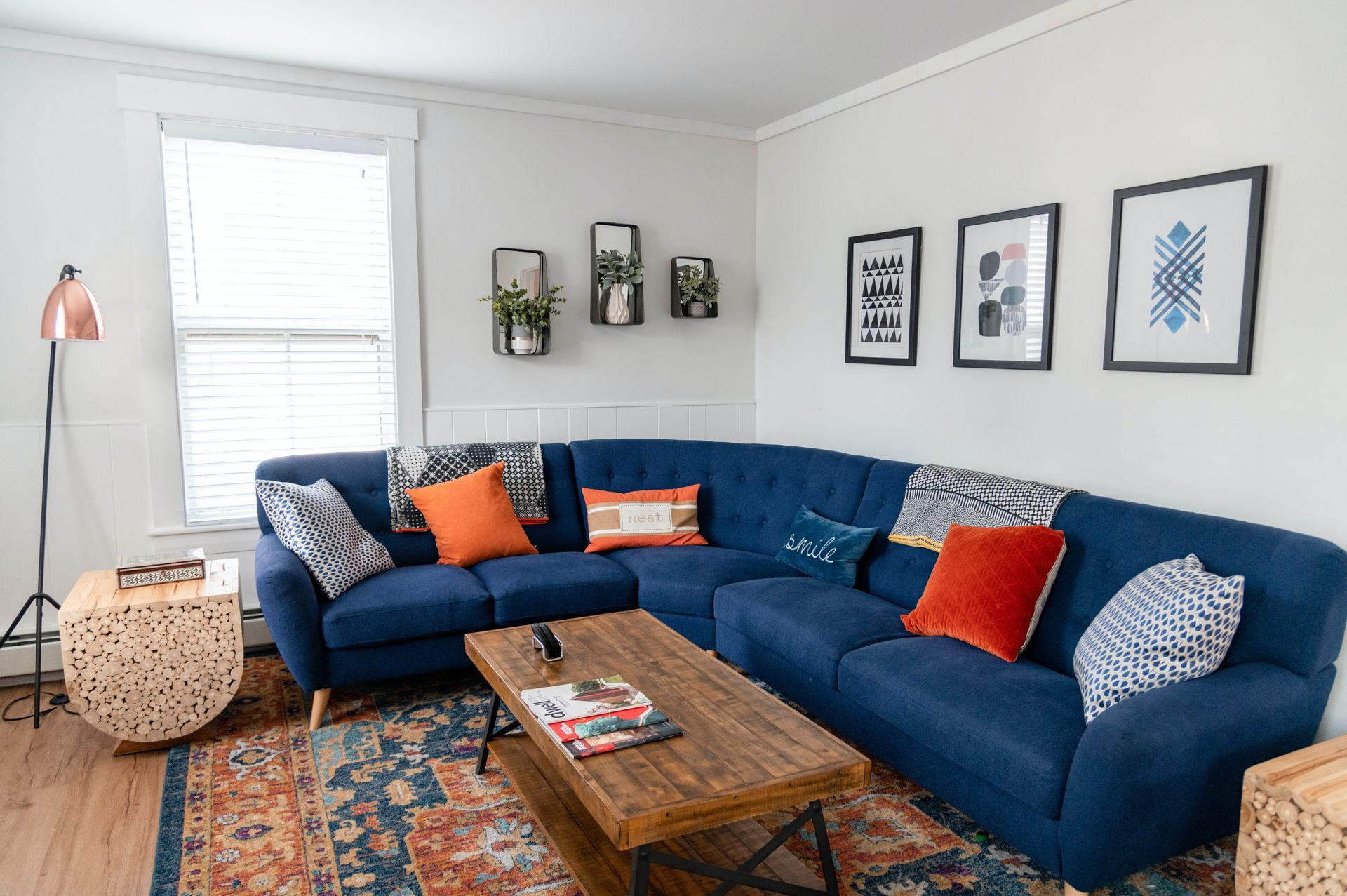
- Solid neutral sofa: let the rug bring pattern and colour — a block-printed dhurrie, a kilim-style geometric or a soft traditional design.
- Bold or patterned sofa: keep the rug plain or textured so the two don’t compete.
- Repeat, don’t match: choose a rug with one or two colours that already appear in your cushions, curtains or art. A rug in the exact shade of the sofa makes both disappear.
- Contrast with the floor: on light marble or vitrified tiles, a mid-tone rug anchors the seating; on dark wooden floors, go lighter.
- Pattern forgives: in a busy home, a mid-tone patterned rug hides daily life, while an all-white rug shows every footprint.
For pairings that work, see our sofa colour combination ideas — and our hall colour combination palettes if you’re choosing wall colour too.
Layering a jute rug in the living room
Layering solves two problems at once: size and budget. Lay a large, plain jute or flat-woven rug as the base — big enough for the front-legs rule — then add a smaller patterned or wool rug on top, centred under the coffee table or set slightly off-centre. Leave a generous border of jute showing on every side, and keep both rugs low-pile so the edges don’t become a trip hazard.
Looking for jute, dhurrie and wool rugs we’d happily recommend? Browse our curated decor finds.
Rug pads, seasonal swaps and care
- Use a rug pad. On marble, vitrified tiles and wood, an anti-slip pad stops slipping and curling corners, protects the floor and adds cushioning. Cut it about 2–3 cm smaller than the rug on every side so it stays hidden.
- Swap with the seasons. Lighter cotton dhurries for summer, wool for winter. Store off-season rugs clean and completely dry, rolled rather than folded, wrapped in breathable cotton with neem leaves or a moth repellent.
- Vacuum weekly. On wool and jute, switch off the rotating brush and use suction only.
- Rotate every few months so wear and sun-fading even out.
- Blot spills, don’t rub. Use as little water as possible on jute and wool, and have wool or hand-knotted rugs professionally cleaned every year or two.
✨ Stylist’s tip
When the budget forces a choice, buy bigger and simpler rather than smaller and fancier. A large plain jute rug or cotton dhurrie that holds the whole seating group makes a room look more finished than an expensive rug floating in the middle. You can always layer a statement rug on top later — but you can’t make a small rug bigger.
Common mistakes to avoid
- Buying too small. If no furniture touches it, it reads as a doormat, not a living room rug.
- Forgetting the door. Check that every door opening into the room clears the rug’s pile.
- Viscose or shaggy rugs in a busy hall. Beautiful on day one, tired within months.
- No pad on tiles. The rug slides, the corners curl and someone trips.
- Matching the sofa exactly. Go a shade lighter or darker, or bring in pattern.
- Trusting the size label online. Check the actual dimensions, pile height and backing in the listing before you order.
FAQs
What size rug do I need for my living room?
Measure the seating, not the room. The rug should run at least 15–20 cm past each end of the sofa, with the front legs of every seat on it. As a guide, 5 × 8 ft suits compact Indian living rooms, 6 × 9 ft mid-sized ones, and 8 × 10 ft or larger works with L-shaped sofas. Tape the outline before you buy.
Which rug material is best for Indian homes?
It depends on how the room is used. Cotton dhurries handle heat, humidity and children well, and many are washable. Jute gives texture but must stay dry. Wool is soft and hard-wearing for cooler cities. Polypropylene is the most practical for pets and heavy use. Avoid viscose and shaggy rugs in a busy living room.
Is a carpet or a rug better for the living room?
For most Indian homes, a rug. When people say living room carpet, they usually mean a large loose rug rather than wall-to-wall carpeting, which traps dust and is hard to keep fresh in hot, humid weather. A loose rug can be lifted, cleaned, rotated and swapped by season — and it moves with you if you rent.
Will a rug make my small living room look smaller?
Not if it’s the right size. A rug that holds the front legs of every seat makes a small room look larger and calmer, because the floor reads as one zone. A small rug floating in the middle does the opposite and chops the floor into pieces. In compact halls, choose a light or mid-tone flat-weave with a quiet pattern.
Want a living room that feels finished — without renovation?
Book a free 15-minute demo call with Styora Decors. Zero obligations — we’ll understand your space and recommend the right plan.
Follow @styoradecors on Instagram and Styora Decors on YouTube for styling reels, rug and living room styling ideas and room makeovers for Indian homes.