
By Styora Decors | Interior Styling & Decor | 9 min read
Your laptop has lived on the dining table, the bed and the sofa arm for months — and by evening, your whole home feels like the office you can’t leave.
Home office design in an Indian flat is rarely about a spare room. It’s about finding one corner — in the bedroom, the living room, next to the balcony door or at the end of the dining table — and setting it up so you can focus during the day and switch off at night. Good light, a comfortable chair, a calm background for video calls and storage that closes are what make it work.
Almost everything here is styling, not construction. You won’t need a renovation, new built-ins or a carpenter for most of these home office decor ideas. Styora Decors is a home styling studio, so we work with your existing furniture plus a few well-chosen buys. Where something genuinely needs a tradesperson, we’ll say so.
Where to put a home office in an Indian flat
Before buying a single thing, pick the spot. The best work corner is the one you can use every day without moving things around, with daylight nearby and a door or a visual break between it and where you rest. Here are the four spots that work most often in apartments.
1. A bedroom corner 🏡
The most common choice, and it works if you keep the desk out of your eyeline from the bed. Put it on the wall beside the bed or behind the headboard wall rather than facing it. A slim 100–120 cm desk usually fits next to a wardrobe or in the gap beside a window.
2. A living room nook
If the bedroom is small or shared, a living room alcove or the wall behind the sofa can hold a narrow console-style desk. It reads as part of the room when it’s styled like furniture — a table lamp, a plant, a tray — rather than a strip of cables and paperwork.
3. Next to the balcony door
Many Indian flats have a few metres of wall beside the balcony door that nobody uses. It brings the best daylight in the home. Just watch the afternoon sun and glare on your screen, and keep a sheer curtain to soften it.
4. A dining table that converts
If there’s truly no corner to spare, make the dining table your desk, but give it a routine. Keep a lidded box or a basket on a nearby shelf for the laptop, chargers and notebooks, and clear the table completely at the end of the day. Our small apartment decorating ideas have more ways to make one surface do two jobs.
Desk placement: light, glare and what’s behind you
Where the desk faces changes how the whole day feels. The ideal is a window to your side — left side if you’re right-handed — so daylight falls across the desk without hitting the screen or your eyes.
- Avoid a window directly behind your screen. Staring into bright daylight all day is tiring, and on video calls your face turns into a dark silhouette.
- Avoid a window directly behind you. It throws glare on the screen and backlights you on camera.
- Don’t push the desk against a blank wall if you can help it. If you must, hang art or a pinboard at eye level so you have something to rest your eyes on.
- Keep it away from the AC’s direct airflow. Sitting under it for eight hours is no fun, and papers fly.
Home office decor ideas for the video-call background
The camera sees what’s behind you more often than anyone sees your actual desk. Treat that wall like a small styled vignette. This is where most of the polish of a work from home setup comes from.
- One styled shelf. A few books stacked flat and upright, a small ceramic vase, a framed print and a trailing plant. Leave space between the objects — a crowded shelf looks messy on a small screen.
- A single large artwork. One piece of art in warm tones reads better on camera than a cluster of small frames.
- A plant at the edge of the frame. A snake plant or a ZZ plant on the floor adds life without stealing attention.
- Never the bed. If the only angle shows the bed, angle the desk differently or place a folding cane screen behind your chair.
Before you style it, open your video app and look at what the camera actually frames. Style only that rectangle. Everything else can stay simple.
Lighting a home office the right way
A work corner needs two kinds of light: task light on the desk and ambient light in the room. A single ceiling tube light or a bright overhead downlight is rarely enough; it creates shadows over your keyboard and makes evenings feel harsh.
- Task light: an adjustable desk lamp placed on the side opposite your writing hand, so your hand doesn’t cast a shadow.
- Ambient light: a floor lamp or table lamp nearby so the screen isn’t the brightest thing in a dark room in the evening.
- Colour of light: neutral white (around 4000K) for the desk during the day; warm white (2700–3000K) for the rest of the room so it still feels like home after work.
- On camera: face the window or a soft lamp. Light from in front of you is the most flattering.
Our home lighting design guide explains how to layer light across the whole room, not just the desk.
✨ Stylist’s tip
Give your work corner an “off switch”. Put the desk lamp on a smart plug or simply make switching it off the last thing you do each day, and keep a cloth or a lidded tray to cover the laptop and papers. When the lamp goes off and the clutter disappears, the corner goes back to being part of your bedroom or living room, and your brain gets the message too.
The chair, the desk height and comfort basics
A home office is only as good as the chair you sit in for hours. You don’t need anything fancy, but a few general basics make a real difference to everyday comfort:
- Pick a chair with back support and a seat height you can adjust, so your feet rest flat on the floor.
- Keep the top of the screen roughly at eye level. A laptop stand or a stack of sturdy books with a separate keyboard does the job.
- Leave enough desk depth (at least 60 cm) for the keyboard and your forearms.
- Stand up and move around regularly. If you have any pain or a specific condition, ask a professional for advice on your setup.
Style matters here too. A cane, wood or upholstered chair in a fabric that matches your room blends in far better than a bulky black gaming chair, especially in a living room nook.
Storage that closes at 6 pm
Open shelves look lovely in photos, but a work corner fills up quickly with chargers, files and receipts. The trick is to keep the surface clear and hide the rest.
- A closed unit or a drawer pedestal under or beside the desk for files and stationery.
- Baskets and boxes in jute, cane or fabric on an open shelf, so contents are hidden but easy to reach.
- Wall organisers such as a pegboard or pinboard, if your walls can be drilled. In rented homes, a freestanding shelf or a ladder shelf works without a single hole.
- Cable management: a cable tray clipped under the desk, Velcro ties, and one surge-protected extension board hidden at the back. Monsoon humidity and dust are kinder to tidy cables, too.
Plants, rugs and soft furnishings to define the zone
Without walls, you need other cues to tell your eye “this is the work corner”. A few soft pieces also help with noise, which matters on calls in flats with hard floors and echo.
- A rug under the desk and chair marks the zone and softens sound. Choose a flat-weave cotton or jute dhurrie so the chair rolls easily. See our guide to choosing a rug for sizing basics.
- Curtains in a heavier cotton or linen absorb sound and help control glare.
- One or two plants on the desk or floor. Money plant, pothos, snake plant and ZZ plant tolerate indoor light and missed watering. Our indoor plants decor ideas show how to style them.
- A cushion and a throw on the chair that match the room, so the corner looks like it belongs.
Office desk decor ideas that don’t turn into clutter
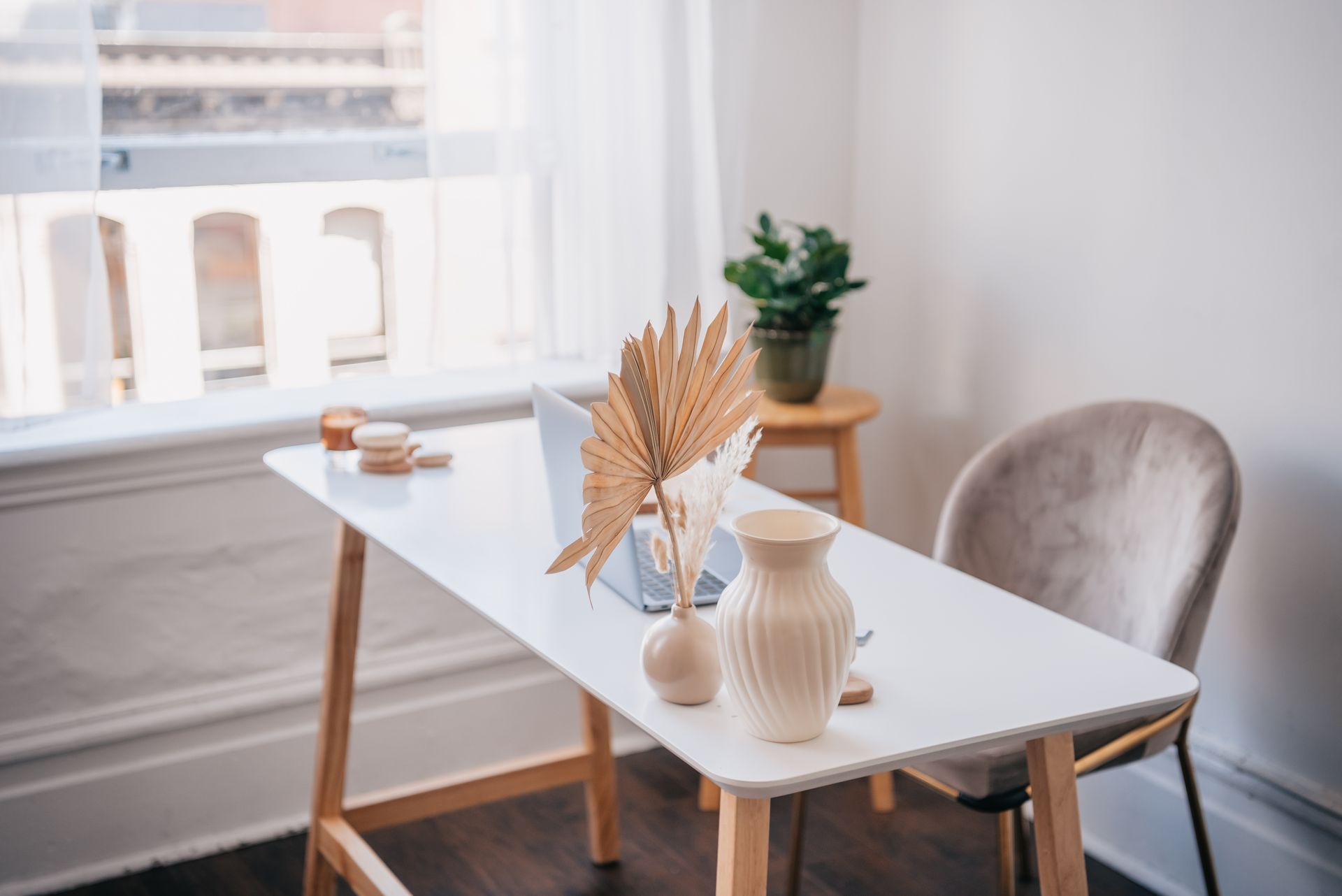
Desk decor should be useful or calming, and there shouldn’t be much of it. A simple rule: three objects plus your work tools.
- A tray to hold the small things, such as pens, earphones and keys
- A small plant or a bud vase with a fresh stem
- One personal object: a framed photo, a brass bell, a handmade ceramic cup for pens
- A notebook and a mug coaster so the mug doesn’t wander
Repeat one material from the rest of the room — brass, cane or wood — in your desk accessories so the work corner feels styled, not added on.
If you’d rather have someone plan the corner with you, our interior styling & decor services start with a free call — no renovation involved.
Common mistakes to avoid
- Working from the bed. It’s bad for comfort, and it blurs the line between rest and work.
- Facing a blank wall with the window behind you. Glare on the screen, a dark face on calls and nothing to rest your eyes on.
- Relying only on the ceiling light. Add a desk lamp and a softer lamp for the evening.
- Buying a desk that’s too big. In a flat, a slim desk that fits the corner beats a large one that blocks a walkway.
- Leaving everything out overnight. Without storage that closes, the corner never feels like home again.
- Over-styling the call background. One shelf, one artwork, one plant. Leave space between them.
FAQs
How do I set up a home office in a small flat?
Pick the spot with daylight to your side that you can use every day without moving things: a bedroom corner, a living room nook or beside the balcony door. Add a slim desk, a supportive chair, a desk lamp and closed storage. A rug under the desk defines the zone without needing walls.
What should be behind me on video calls?
A simple styled background: one shelf with a few books, a small vase and a plant, or one large artwork. Keep a light source in front of you, not behind. Avoid a visible bed, a cluttered cupboard or a bright window. Check the camera frame first, then style only what it shows.
What is the best home office design for a bedroom?
Keep the desk out of your direct view from the bed, ideally on a side wall. Use storage that closes, match the desk and chair to the bedroom’s materials and colours, and switch off the desk lamp at the end of the day. A folding screen can hide the corner at night.
Do I need a carpenter for a home office corner?
Usually not. A ready-made desk, a freestanding shelf, baskets, a lamp, a rug and a plant are enough for most work from home setups. You’d only need a carpenter for a custom built-in desk or wall-mounted cabinets, and a painter only if you want a new wall colour.
Want a work corner that feels like home — without renovation?
Book a free 15-minute demo call with Styora Decors. Zero obligations — we’ll understand your space and recommend the right plan.
Follow @styoradecors on Instagram and Styora Decors on YouTube for styling reels and room makeovers for Indian homes.